
Tracking of Devices via Cell ID Geolocation (SIM Tracking)

Martin Pløger
December 18, 2025
NexCon.io offers a Geolocation API as an added service that can be used to view the location of your IoT SIM cards worldwide based on the cell sites to which the SIM cards are connected. The technology, also known as "SIM tracking," makes it easy to integrate location data directly into your connected IoT devices without relying on GPS equipment.
If you would like to use the geolocation API, please contact your account manager or write to us via the support chat, and we will help you get started.
How does cell ID geolocation work?
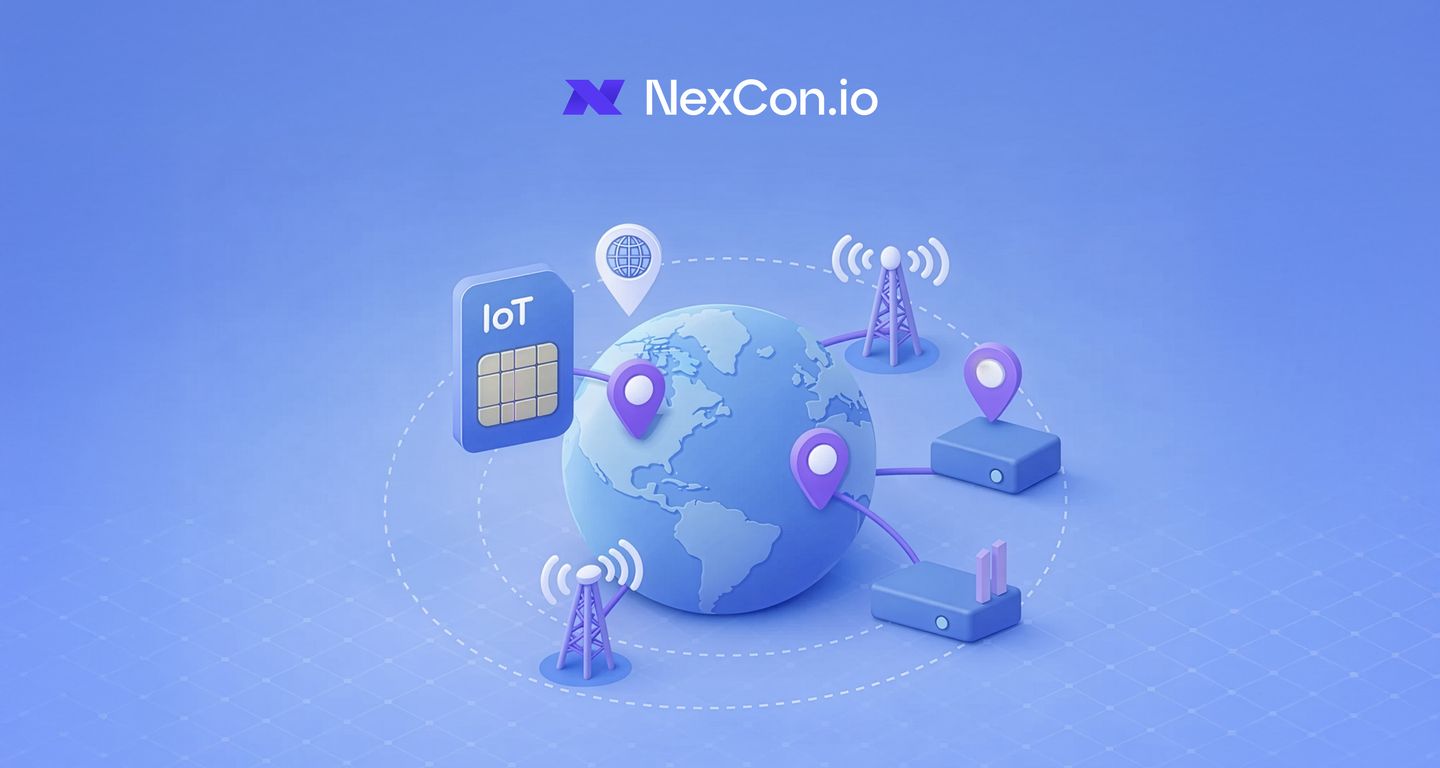
Our cell ID geolocation solution works by sending a request at the API level to obtain the location of a specific SIM via its unique ICC number, which is typically 18 to 22 characters long. The location is then determined based on information about the cell site to which the IoT SIM card is connected. Using a database containing the coordinates of over 200 million sites worldwide, it is possible to determine the approximate location of the connected IoT device containing the SIM card.
Cell sites are typically located in strategic positions, often or indoors in large buildings. See the open OpenCelliD project maintained by Unwired Labs to view the location of sites worldwide.
Example of a specified location in the US, where the accuracy is 500 meters:
{
  "eventId": "60d5ec49f1a2c8b1f8e4b0a1",
  "status": "SUCCEEDED",
  "createdAt": "2025-11-01T12:00:00Z",
  "updatedAt": "2025-11-01T12:05:00Z",
  "data": {
    "lat": 41.366559,
    "lon": -75.570403,
    "accuracy": 500,
    "address": "Circle Drive, Elmbrook Terrace, Roaring Brook Township, Lackawanna County, Pennsylvania, 18444, USA"
  }
}
When does cell ID geolocation make sense?
Cell ID geolocation can be used independently as a cost- and energy-efficient method for tracking devices or as a backup for GPS tracking. Whether cell geolocation can be used entirely as a replacement for GPS tracking depends on your specific use case and desired level of accuracy.
In large cities, where there is high coverage with many cell sites, the technology is relatively accurate. However, in sparsely populated areas with several kilometers between the sites, the accuracy drops dramatically.
Examples of use cases where cell-ID geolocation makes sense:
Backup location when GPS fails
GPS devices often lose signal, e.g. indoors, underground, during storms or in urban canyons. Here, cell geolocation can serve as a stable fallback that can provide a rough position. This ensures that you can still track the approximate movement of vehicles and equipment during periods of blackout, thus ensuring continuity in the tracking data.
Cost savings by replacing GPS hardware
For some IoT products, it is sufficient to know the approximate location of the device, and here cell geolocation can replace expensive GPS modules and ongoing GPS operating costs. The result is a significantly cheaper device with lower service costs.
Asset tracking
Ideal when you just need to know which region or city your equipment is located in. Typically used for machines, tools, generators and rental equipment. The technology can also provide a quick area estimate when a device disappears.
Tracking shipments combined with known locations
Cell geolocation is useful for tracking shipments, for example, where a position can be linked to known locations such as warehouses, terminals or ports. This allows you to see if a shipment has arrived in the expected area, even without a precise GPS location.
Validation of the device's expected location
Good for stationary IoT devices such as charging stations, heat pumps, meters and industrial sensors that do not normally move. The technology meets the need to see if the device is still in the "right place."
Geofencing
Cell ID geolocation can be used for geofencing equipment that is rarely moved. The device is monitored based on which cell sites it connects to, and if it is suddenly detected outside the defined zone, an alert is triggered. This makes it possible to detect unauthorized movements in an energy-efficient and operationally stable manner.
What should you be aware of?
At NexCon.io, cell geolocation is only available for SIMs with an active data session, and only if the account has the geolocation feature enabled. If the feature is not enabled, or if there is no active session or location data, the API will return an error message.
You should also be aware of the following:
- Geolocation only works when the SIM card is connected via an approved NexCon.io APN. If the device is connected through another APN, geolocation data will not be accessible.
- Your "SIM Data World Map" in the NexCon.io dashboard shows an overview of your SIMs at the country level, e.g., Denmark, Germany, the United States etc., and therefore not exact positions that cell ID geolocation provides access to.
- A network is not guaranteed to disclose location data for a SIM, and there may be cases where the position is not returned.
We connect the technologies of the future via intelligent IoT SIM solutions
At NexCon.io, we specialize in providing intelligent IoT solutions tailored to your business needs. As a customer, you can purchase IoT SIM cards and eSIMs directly from our web shop and easily manage them afterwards in the dashboard with several available features such as data pools, mass editing and IMEI locking.
By choosing NexCon.io, you get unmatched support, flexibility and quality that ensures your devices stay connected.
Create your free account in less than two minutes here, or contact our sales team at hi@nexcon.io to find the best possible solution for you.